


Free Thesis Statement Generator – How to Use + Examples
Writing a thesis statement can feel like standing at a crossroads. Too broad, and the paper drifts. Too narrow, and it collapses.
I’ve seen students freeze at this point more times than I can count. That’s where a free thesis statement generator earns its place. Not as a shortcut, but as a starting line.
This guide first explains what it does, then shows how to use it properly, and finally demonstrates what strong results look like in real assignments.
What Is a Free Thesis Statement Generator?
A free thesis statement generator creates a clear, topic-focused thesis sentence based on keywords, arguments, or research direction you enter.
It not only follows standard academic structure, but also supports essay focus, and moreover aligns with grading rubrics used in schools and universities.
That’s the job.
Nothing more.
Nothing less.
These tools don’t write your essay. They shape the spine.
Why Thesis Statements Fail So Often
Most thesis problems start early. Although the topic sounds fine, the issue is that the sentence doesn’t.
I’ve reviewed papers where, although the introduction looked solid, the problem was that the thesis said nothing.
No claim.
No direction.
Common issues show up again and again:
- Vague wording
- Topic summaries instead of claims
- Opinions with no angle
- Questions posing as statements
A generator helps fix structure before confusion spreads across five pages.
When Should You Use a Thesis Statement Generator?
Timing matters. Use it early.
A thesis generator works best after topic approval but before outlining. That window saves hours.
I’ve seen students write full drafts only to rewrite everything once the thesis falls apart. That’s wasted effort. A generator stops that spiral.
How Does a Thesis Statement Generator Work?
The tool uses sentence frameworks taught in academic writing guides. Next, you enter a topic, stance, or research angle, and then the output follows a claim-based structure.
Most tools focus on:
- Topic clarity
- Argument direction
- Cause-and-effect logic
- Comparison or position framing
This mirrors how instructors score clarity and focus.
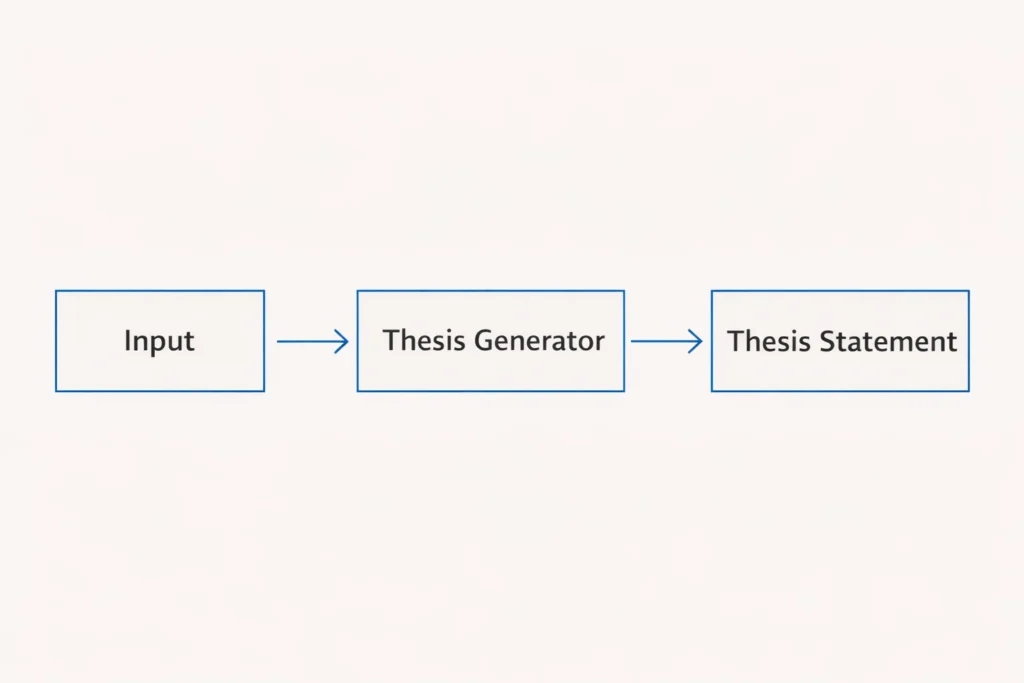
How to Use a Free Thesis Statement Generator Step by Step
Step 1: Start With a Narrow Topic
Broad topics break papers. Narrow ones guide them.
Instead of “social media,” try “Instagram use and teenage sleep.” That focus sharpens everything that follows.
Step 2: Decide Your Position
Since every thesis needs a stance, neutral summaries, therefore, don’t pass.
Ask one simple question.
What am I claiming?
Your answer becomes the backbone.

Step 3: Enter Clear Keywords
When input is messy, it leads to weak output; however, clean input brings clean sentences.
Use specific terms.
Avoid filler.
Step 4: Review and Adjust
The first result rarely fits perfectly. That’s normal.
First, read it aloud. If it sounds like something a teacher would underline, then you’re close. Next, edit wording, not direction.
What Makes a Strong Thesis Statement?
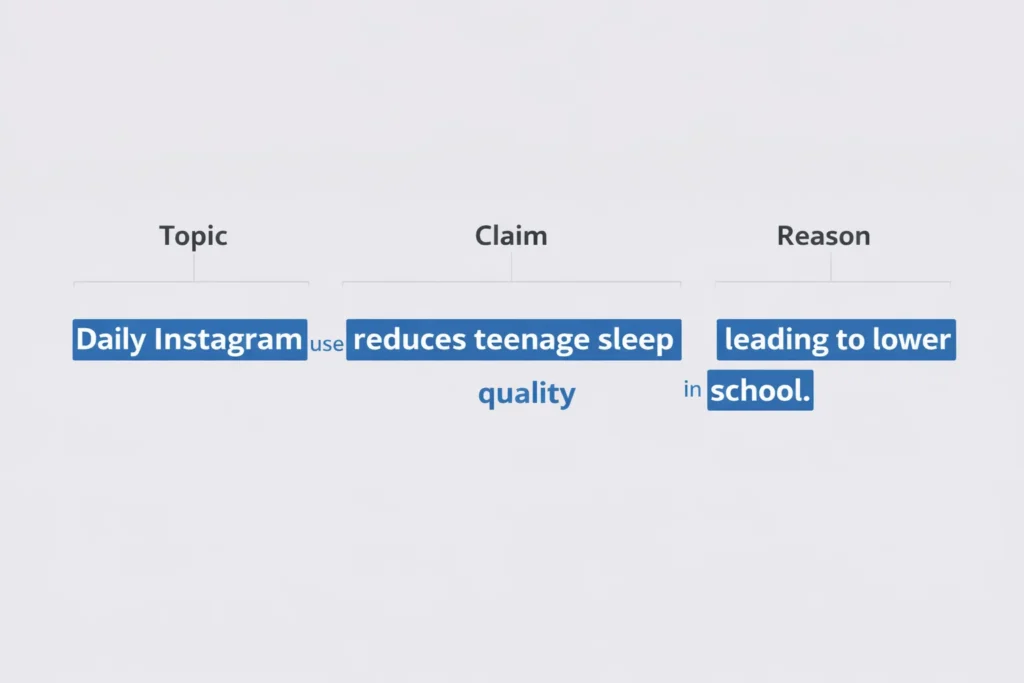
A strong thesis does three things fast.
It names the topic.
It states the claim.
Signals why it matters.
If one of those parts is missing, the sentence falls flat.
Think of it like a road sign.
Clear direction.
No decoration.
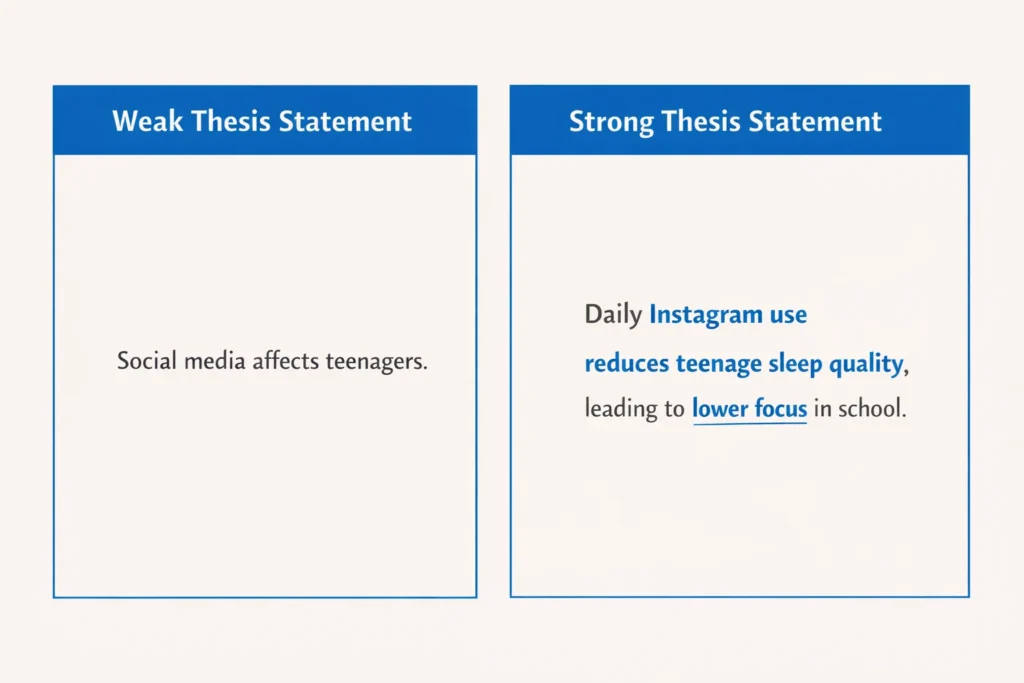
Weak vs Strong Thesis Examples
Weak Example
Social media affects teenagers.
This says nothing new.
It dodges commitment.
It invites vague writing.
Strong Example
Because daily Instagram use reduces teenage sleep quality, it consequently lowers focus and academic performance.
This works.
The claim is clear.
The scope stays controlled.
That difference alone can raise a paper’s score.
Example Inputs and Outputs From a Thesis Generator
Example 1: Argument Essay
Input: climate change, agriculture, food security
Output: Climate change threatens global food security by reducing crop yields and increasing farming instability.
Clear.
Focused.
Defensible.
Example 2: Analytical Essay
Input: online learning, university students, motivation
Output: Online learning environments reduce student motivation by limiting peer interaction and structured accountability.
The sentence sets direction.
The essay knows where to go.
Can Teachers Detect Generator Use?
Short answer.
No.
Long answer.
They notice weak thinking, not tools.
While instructors care about clarity and logic, they do not concern themselves with how the first sentence took shape.
Problems only appear when students copy blindly and fail to support the claim.
A generator gives structure.
You supply proof.
Where Students Go Wrong With These Tools
The biggest mistake shows up fast, especially when there’s blind trust.
A generator doesn’t know your rubric, nor does it know your sources.
I’ve seen students submit strong-sounding theses that didn’t match their evidence. As a result, that disconnect costs marks.
Always check alignment.
How Thesis Generators Support Better Grades
Because grading rubrics reward clarity, they also punish confusion.
A focused thesis helps:
- Tighter introductions
- Clear topic sentences
- Logical paragraph flow
- Strong conclusions
This isn’t theory.
It’s how papers get scored.
Best Subjects to Use Thesis Generators For
Some subjects benefit more than others.
They work well for:
- English literature
- Social sciences
- Education
- Business studies
- Media studies
Highly technical fields still need manual adjustment.
Structure still helps.

Are Free Tools Enough?
For most students, yes.
Paid tools add features; however, they don’t replace thinking. Meanwhile, a free generator handles structure, while your research handles substance.
That balance works.
Final Thoughts on Using Thesis Generators Wisely
A thesis statement sets the tone; if you get it wrong, then everything wobbles.
Although a free thesis statement generator doesn’t replace effort, it helps remove guesswork.
When used properly, it not only saves time but also sharpens focus and keeps writing on track, which is the real value.