


How to Improve a Weak Thesis Statement (Step-by-Step)
A weak thesis hurts fast.
A weak thesis sinks an article before it starts. Readers feel lost. Teachers feel unconvinced. Search engines feel unsure. I’ve fixed hundreds of them, and the pattern stays the same. Try our Thesis Statement Generator to get a clear, focused thesis in seconds. Weak thesis lack focus, direction, or proof.
What makes a thesis weak?
A thesis becomes weak when it lacks a clear claim, a specific scope, or a reason that can be supported through writing. These issues make the argument vague, overly broad, or descriptive, which leads to confusion for the reader.
Most weak theses sound safe. They sit on the fence. They describe a topic instead of making a claim.
Here’s a common example.
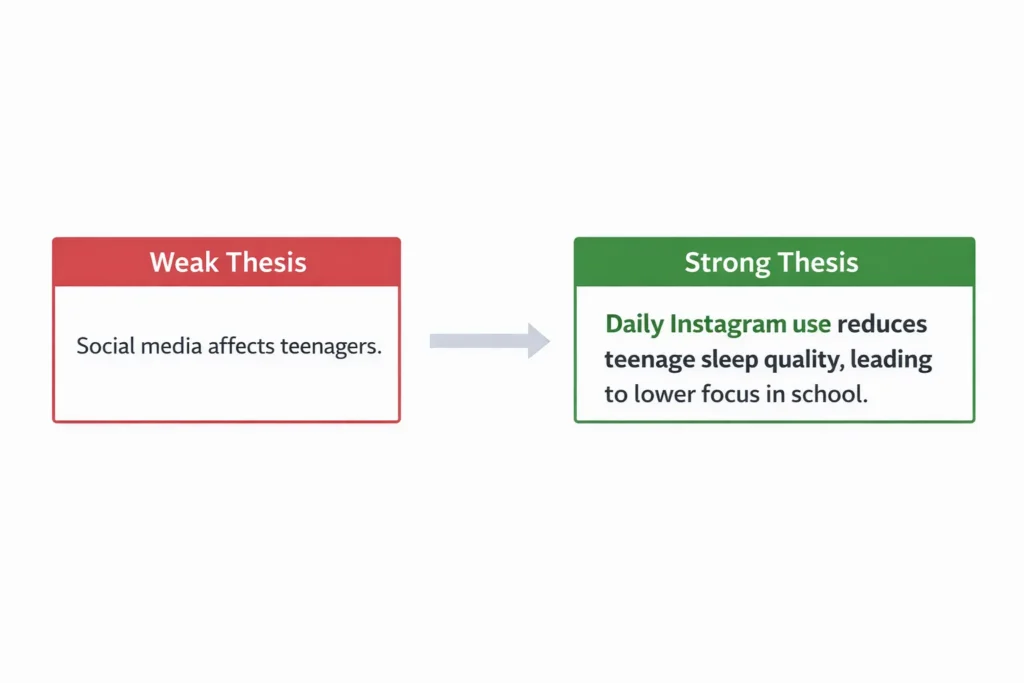
Social media affects teenagers.
That line says nothing new. It promises nothing. It gives the writer no lane to stay in.
According to writing centre guidance from Purdue University, essays that include a clearly defined thesis statement therefore tend to score higher in clarity and organization on instructor grading rubrics.
(Source: Purdue Online Writing Lab)
Step 1: Spot the real problem
To begin with, the first fix starts with honesty. Before anything else, ask one hard question: What’s missing here?
Most weak theses fail in one of three ways.
- Too broad
- It may be too obvious
- Too neutral
In simple terms, think of a thesis like a GPS pin. If it drops in the middle of the ocean, then nobody knows where to go.
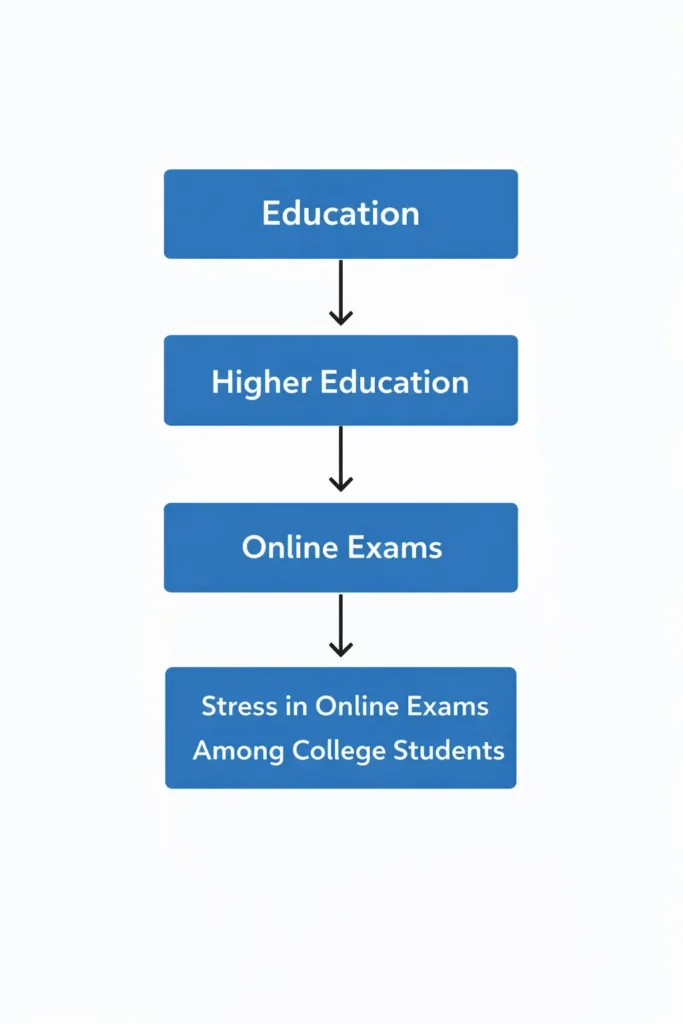
Step 2: Cut the topic size
Big topics create weak theses. Smaller topics force clarity.
Let’s shrink this.
Social media affects teenagers.
Now tighten it.
Daily Instagram use affects teenage sleep habits.
The fog clears fast. The reader now knows the focus.
Step 3: Add a clear position
Most importantly, a thesis must take a side. Otherwise, neutral lines don’t persuade anyone.
Look at this.
Daily Instagram use affects teenage sleep habits.
Better, but still flat. Now add direction.
In particular, daily Instagram use reduces teenage sleep quality by delaying bedtime routines.
That’s a claim. It invites proof. It invites debate.
Step 4: Answer the “so what” test
Ultimately, every strong thesis answers one silent question: Why should I care?
As a result, if the thesis doesn’t hint at impact, readers drift away.
Let’s push it once more.
As a result, daily Instagram use reduces teenage sleep quality, leading to lower focus in school.

Now the point lands. Cause and effect feel clear.
Research cited by the National Sleep Foundation shows that smartphone use before bedtime reduces average sleep duration by 30 to 60 minutes per night among teenagers.
Step 5: Remove soft language
Soft words weaken strong ideas. They act like loose screws.
Watch for phrases like:
- may affect
- could lead to
- seems to suggest
Replace them with firm language backed by evidence.
Compare this.
Phone use may affect sleep.
With this.
Phone use delays sleep by increasing screen exposure before bedtime.
Confidence grows when wording tightens.
Step 6: Match thesis to evidence
A thesis can’t stand alone. Evidence holds it upright.
Before locking the thesis, scan the sources. Do they support the claim?
For this reason, if the evidence feels thin, narrow the claim. Otherwise, don’t stretch facts like elastic.
Step 7: Check sentence structure
In contrast, long sentences blur meaning. By comparison, short ones punch harder.
A thesis should fit on one breath. If it runs long, trim it.
Bad structure example.
Due to various reasons related to technology usage among modern teenagers, sleep schedules are impacted in different ways.
Fixed version.
In many cases, night-time phone use delays sleep schedules for most teenagers.”
Same idea. Cleaner hit.
Step 8: Align with assignment goals
A strong thesis fits the task. A mismatch breaks trust.
Specifically, an analytical essay needs analysis, a persuasive essay needs a stance, and a research paper needs proof.
Read the prompt again. Match the thesis tone to the goal.
Think of it like shoes. Running shoes don’t belong at a wedding.
Step 9: Test it aloud
Read the thesis out loud. Listen for wobble.
If it sounds unsure, it probably reads that way too.
In essence, a strong thesis sounds calm. It doesn’t rush, and it doesn’t apologize.
This test catches problems fast.
Step 10: Ask one smart question
Before finalizing, ask this.
Can someone disagree with this?
Consequently, if the answer feels like ‘no,’ the thesis lacks bite.
Debate fuels strong writing. Silence kills it.
Weak vs strong thesis examples
Seeing the contrast helps lock the idea.
Weak:
Pollution harms the environment.
Strong:
Plastic waste in rivers increases flooding risks in urban areas.
Weak:
Online learning has pros and cons.
Strong:
Online learning lowers engagement in first-year college students without structured schedules.
Each strong version points somewhere specific.
Common mistakes to avoid
These common mistakes show up often.
- Turning the thesis into a question
- Listing facts instead of claims
- Writing a summary instead of an argument
In fact, a thesis isn’t a table of contents; rather, it’s a promise.
How teachers read a thesis
Teachers scan fast. They look for control.
A strong thesis signals confidence. It shows the writer knows the destination.
Weak theses raise red flags. They suggest a messy paper ahead.
Think of the thesis as a handshake. First impressions stick.
How search engines read a thesis
Search engines value clarity. Clear claims help topic signals.
A focused thesis improves keyword alignment. It reduces bounce risk.
For online content, this matters a lot.
Editing checklist
Run this quick list before submission.
- One clear claim
- One focused topic
- One visible impact
- One sentence
If all boxes tick, you’re close.
Final thought
A thesis doesn’t need flair. It needs control.
When the thesis locks in, the rest of the writing flows. Paragraphs behave. Evidence falls into place.
Fix the thesis first. Everything else follows.